Do individual actions matter for the climate?

This week I’ve listened to my favourite podcast: How to Save a Planet. One of their episodes Is Your Carbon Footprint BS looks at whether your individual actions actually matter when it comes to addressing global carbon emissions. I enjoyed the episode so much that I’m sharing my main takeaways here.

“You’re just a rounding error in global carbon emissions”
On the one hand, your individual actions don’t matter. Even if you are living in a rich country with a way above average footprint, changing your individual actions has a miniscule impact on the actual emissions going into the atmosphere.

In the words Dr. Katherine Wilkinson, climate communicator extraordinaire: This is a good thing! We’d be in a lot of trouble if in order to solve climate change we needed everyone to do what’s exactly right every time.

On the other hand, what we do as individuals does matter.

Think of your actions as a form of communication to invite others to act. The action is important, but talking about it is even more important! Shame and guilt doesn’t help here; we need to focus on how powerful we are when we come together.

Align your day to day actions and habits so that they keep you focused and excited about the world that we want to create, but don’t focus all your effort on your own individual action.

Making ripples
We have to think with our greatest leverage to make as much difference as possible when it comes to climate change. Because we need to make a lot of difference in a short time.

How can you make ripples? Where is the sphere of influence with actions outside of just reducing your own carbon footprint. Think in ever expanding circles of influence, and start with what is just one circle outside of you. What are the actions in that layer? Your workplace, group of friends, community.

What should you do?

Finding your place to be active in the transition to a just and livable future might seem quite daunting. Where do you even start?! The episode suggests drawing yourself a Venn diagram to help you narrow it down – and who doesn’t like a good, applicable Venn diagram!
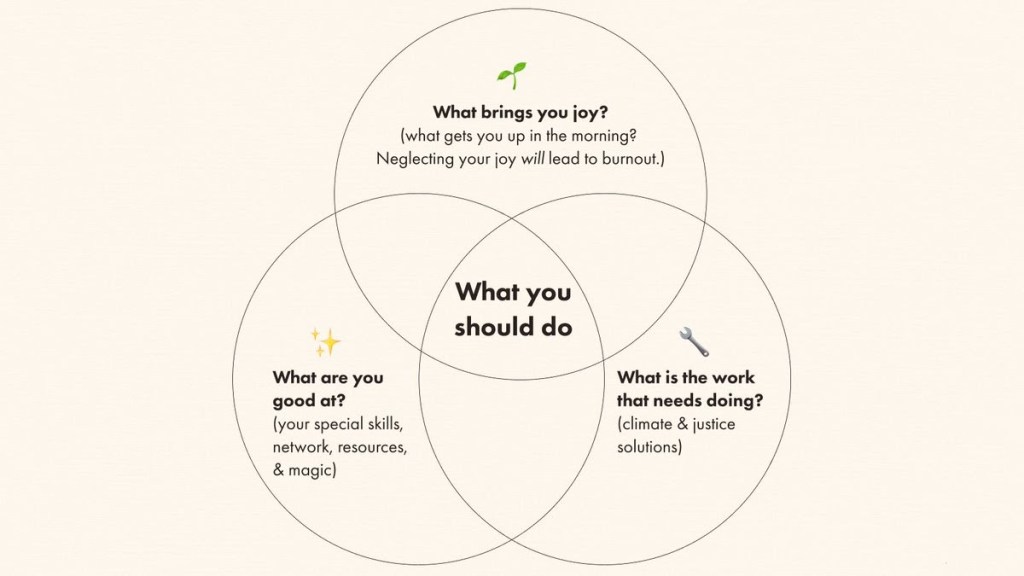
Image from How to save a planet resources.

What are you good at?
What do you bring to the table? What are skills and experiences that you have that can be of use in this challenge? If this is difficult for you to think about or come up with, start by listing things that you have done and delivered. This can include work, but also hobby projects, events or parties, community activities etc. It also includes your network, such as access to people and resources.

What is the work that needs to be done?
There are so many facets to the systemic challenge that is climate change. On one hand, this can feel really overwhelming: the problem feels really big and insurmountable and intractable, and you’re only one tiny human. On the other hand – you don’t have to solve it all yourself! And there’s space for everyone! You get to pick the part you want to focus on!

If you like getting into the big picture of what needs to be done in a structured and accessible way, check out Project Drawdown that has a list of the climate solutions for each sector that are already available to us. I’m positive it will provide you with several entry points to potential action.

Your work may also be to build a bigger team and bring more people to the table; perhaps help others find their role in the movement. All kinds of people are needed!

What brings you joy?
Mitigating and adapting to climate change is the work of our lifetime, and you need to be able to draw joy and energy from this work, or you’ll quickly burn out. Aligning your climate work with what brings you joy will help you sustain this in the long term, and that’s what we all need.

And finally
Don’t wait and agonise to find the “perfect” fit. Get started, and as you progress on the journey, you’ll contintue to learn, find and develop new strengths, and find unexpected sources of joy.

The writing habit

“Start telling the stories only you can tell There’ll always be better writers than you. There’ll always be smarter writers than you. There will always be people who are much better at doing this or doing that – but you are the only you.”

Neil Gaiman

This year, I’m working to build a writing habit to get out of a 14-year writing block. I’m working on what stories I can tell, and building the habit of putting thoughts on virtual paper, and putting them out into the world.

So far, it’s going alright. While I might not always be publishing here on the website, or through other media, I’m chipping away getting words out of my head and down in writing, in whatever form, and building that writing habit.

“Every action you take is a vote for the type of person you wish to become. No single instance will transform your beliefs, but as the votes build up, so does the evidence of your identity. This is why habits are crucial. They cast repeated votes for being a type of person.”

James Clear

For example, the type of person who writes things and publishes them on the internet for other people to read.

Three stories that spoke to me in 2021

Octavia Butler – Kindred

Kindred – Octavia Butler

Octavia Butler was an absolute trailblazer in science fiction; a genre that when she was young had a distinct lack of female protagonists, as well as a lazy approach to writing about ethnicity and class. However, labeling Octavia Butler a science fiction writer does her a disservice, as it makes people who “don’t like science fiction” unlikely to pick up her books.
Kindred is an incredibly gripping story that blends time travel, slavery, feminism, complex characters and excellent storytelling. It brings to life the long shadow of slavery and power dynamics that existed and that persist over American society today. The book defies general genre-placing, and is in the words of Butler herself, it’s “kind of a grim fantasy”.

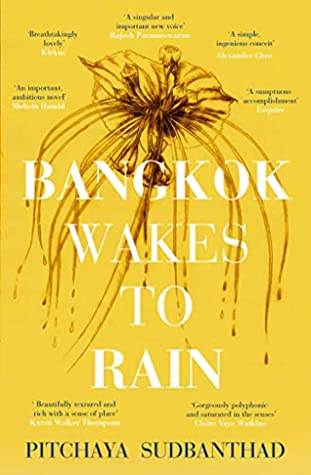
Pitchaya Subanthad – Bangkok Wakes to Rain

Bangkok Wakes to Rain – Pitchaya Subanthad

The sublimely interlinked and carefully crafted narrative arc of the different protagonists in Bangkok Wakes to Rain is subtle and beautiful. Similar to The Man with the Compound Eyes (on my 2020 favourites list) it addresses climate change obliquely through the effects that it has on Bangkok. It takes us into a future where the flooded remnants of “Old Bangkok” is used to examine our sense of home and how we shape and retain memories of places and who we are. It is an incredibly human book, bringing its characters to life with complexity and tenderness.

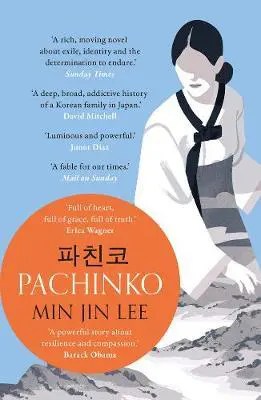
Min Jin Lee – Pachinko

Pachinko – Min Jin Lee

The family story and experience set out in Pachinko takes us from 1910 through to 1989 across Korea and Japan. Through one family’s eyes, we experiences racism and stereotypes encountered by Koreans in Japan. It is an epic historical fiction, covering both the annexation of Korea by Japan, and WWII. Power dynamics, love, history unfolding and our freedom to make decisions within our lifetime are all big themes that are tackled beautifully.

What stories have spoken to you recently?

“Most people spend most of their lives letting rooms tell them how to feel”

This week was our work Christmas party, but on the day I was feeling more Grinch than Santa’s Little Helper.

I was tired, the weather was awful, I was travelling to the venue from home, on my own. I had a looming client deadline and an important team mate who had to take sick leave.

As I plodded up from the station towards the brightly lit entrance, head bowed against the wind and rain, I contemplated how long I would have to stay before I could escape back home. Luckily, I have been part of a course called Upfront for the past month, and reminded myself that if I felt this way, chances are that other people coming that evening felt the same reluctance to show up on their own, not sure who they would know and unaccustomed to socialising with colleagues.

So I decided to take inspiration from this excellent TED talk by Deborah Frances-White and decide: how did I want to change the room? How did I want people to feel after speaking to me that evening?

As I entered the room, a series of heads swivelled to see who the latest arrival was. With most of the room’s eyes on me, I spread my arms out wide, smiled and said “Wow, this is quite the welcome committee!”. And just like that, I got started.

“[Pity that] consequences are determined not by excuses but by actions!”

This is a quote I come back to regularly, from George Eliot’s Adam Bede. The context of the quote is in wrongdoing, where one character has behaved badly and is looking for redeeming factors, thinking “if ever a man had excuses, he had”.

When I originally encountered this quote, I wrote it down because I liked the turn of phrase. When I remembered it several years later, it resonated because I had recently been treated horribly by someone I really cared for. That person apologised, but it made no difference to the outcome – or to my feelings – and I found the quote perfectly summed that up and provided me with some comfort.

Fast forward, and the meaning of this quote has changed for me. The original association with wrongdoing is all but gone, and I now see it as a call to action: consequences are determined by what you do. if you truly want something, you take steps to get there. There will always be excuses or reasons you can’t do something (I don’t have time, I’m tired, I don’t know enough), but growth happens outside of your comfort zone, and making excuses to stay in that comfort zone won’t get you where you want to be. So call out your own excuses and get going.

And on the flipside of that, you are allowed to not do something, whether you give yourself “excuses” or not. If I choose to not do something, that is also an action, and that action will have consequences, positive or negative: I might be more rested with a clearer head, or feel like I missed out.

I’m using the quote as a balancer what is it I’m enabling and working towards with my actions, and are they – however imperfectly – taking me towards that?

With my second public post in two days, I’d like to think so!