This week I’ve listened to my favourite podcast: How to Save a Planet. One of their episodes Is Your Carbon Footprint BS looks at whether your individual actions actually matter when it comes to addressing global carbon emissions. I enjoyed the episode so much that I’m sharing my main takeaways here.
“You’re just a rounding error in global carbon emissions”
On the one hand, your individual actions don’t matter. Even if you are living in a rich country with a way above average footprint, changing your individual actions has a miniscule impact on the actual emissions going into the atmosphere.
In the words Dr. Katherine Wilkinson, climate communicator extraordinaire: This is a good thing! We’d be in a lot of trouble if in order to solve climate change we needed everyone to do what’s exactly right every time.
On the other hand, what we do as individuals does matter.
Think of your actions as a form of communication to invite others to act. The action is important, but talking about it is even more important! Shame and guilt doesn’t help here; we need to focus on how powerful we are when we come together.
Align your day to day actions and habits so that they keep you focused and excited about the world that we want to create, but don’t focus all your effort on your own individual action.
Making ripples
We have to think with our greatest leverage to make as much difference as possible when it comes to climate change. Because we need to make a lot of difference in a short time.
How can you make ripples? Where is the sphere of influence with actions outside of just reducing your own carbon footprint. Think in ever expanding circles of influence, and start with what is just one circle outside of you. What are the actions in that layer? Your workplace, group of friends, community.
What should you do?
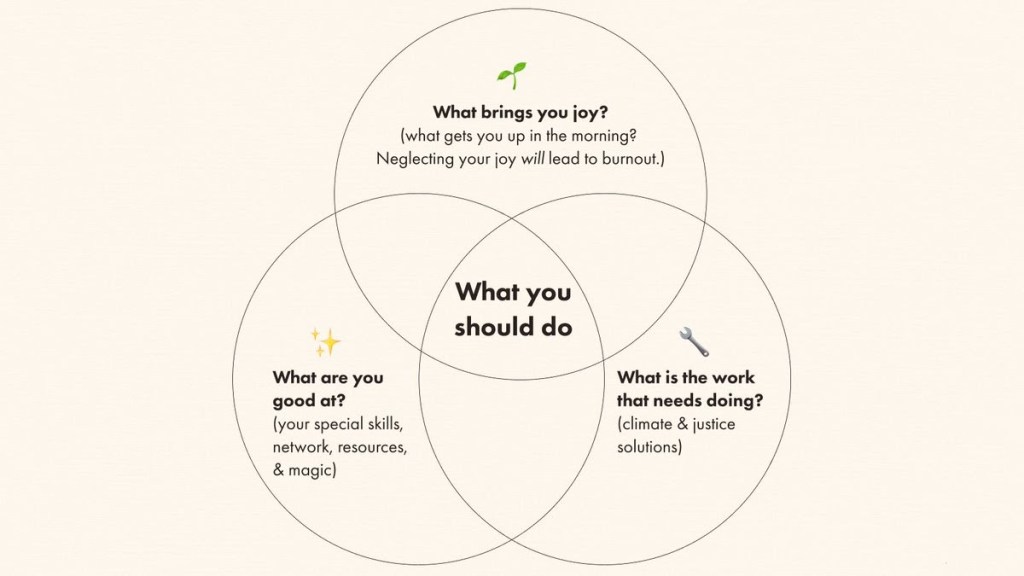
Finding your place to be active in the transition to a just and livable future might seem quite daunting. Where do you even start?! The episode suggests drawing yourself a Venn diagram to help you narrow it down – and who doesn’t like a good, applicable Venn diagram!
What are you good at?
What do you bring to the table? What are skills and experiences that you have that can be of use in this challenge? If this is difficult for you to think about or come up with, start by listing things that you have done and delivered. This can include work, but also hobby projects, events or parties, community activities etc. It also includes your network, such as access to people and resources.
What is the work that needs to be done?
There are so many facets to the systemic challenge that is climate change. On one hand, this can feel really overwhelming: the problem feels really big and insurmountable and intractable, and you’re only one tiny human. On the other hand – you don’t have to solve it all yourself! And there’s space for everyone! You get to pick the part you want to focus on!
If you like getting into the big picture of what needs to be done in a structured and accessible way, check out Project Drawdown that has a list of the climate solutions for each sector that are already available to us. I’m positive it will provide you with several entry points to potential action.
Your work may also be to build a bigger team and bring more people to the table; perhaps help others find their role in the movement. All kinds of people are needed!
What brings you joy?
Mitigating and adapting to climate change is the work of our lifetime, and you need to be able to draw joy and energy from this work, or you’ll quickly burn out. Aligning your climate work with what brings you joy will help you sustain this in the long term, and that’s what we all need.
And finally
Don’t wait and agonise to find the “perfect” fit. Get started, and as you progress on the journey, you’ll contintue to learn, find and develop new strengths, and find unexpected sources of joy.
 Cecilia Isvén